

Crossed Roller Slewing Bearings: When to Choose Them Over Ball Types
Crossed Roller Slewing Bearings: When to Choose Them Over Ball Types
Both crossed-roller and four-point ball slewing bearings sit in the same envelope and carry the
same three load components — axial force Fa, radial force Fr, and overturning
moment M. The difference is the rolling element, and that single difference decides where
each type belongs. Pick wrong and you either overpay for capacity you never use, or watch a ball
ring develop play and noise the moment the load turns moment-dominated.
This guide gives you the decision rule, a side-by-side table, and a sizing example so you can
specify the right ring without guessing. If you first need the broader load-case method, our
slewing bearing selection overview covers building the load case itself.
1. Two ways to carry one combined load
A slewing bearing’s job is to hold a structure that pushes down, pulls sideways, and tries to
tip over — all at once. Two single-row designs do this with very different mechanics.
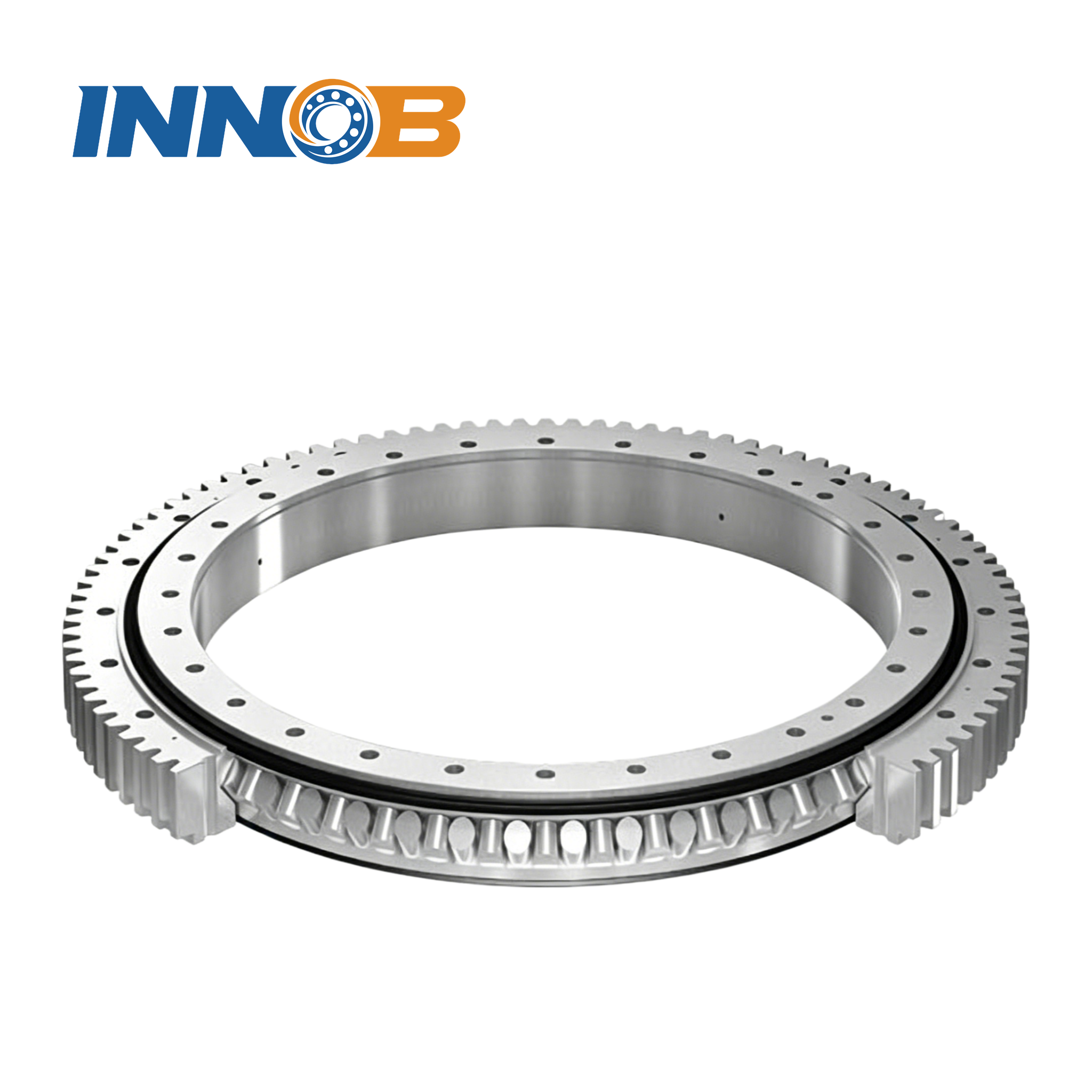
Four-point contact ball. One row of balls runs in a single gothic-arch (or
circular) groove that touches each ball at four points. That geometry lets a single row
absorb axial, radial, and moment load simultaneously. It is simple, light, and cheap to make.
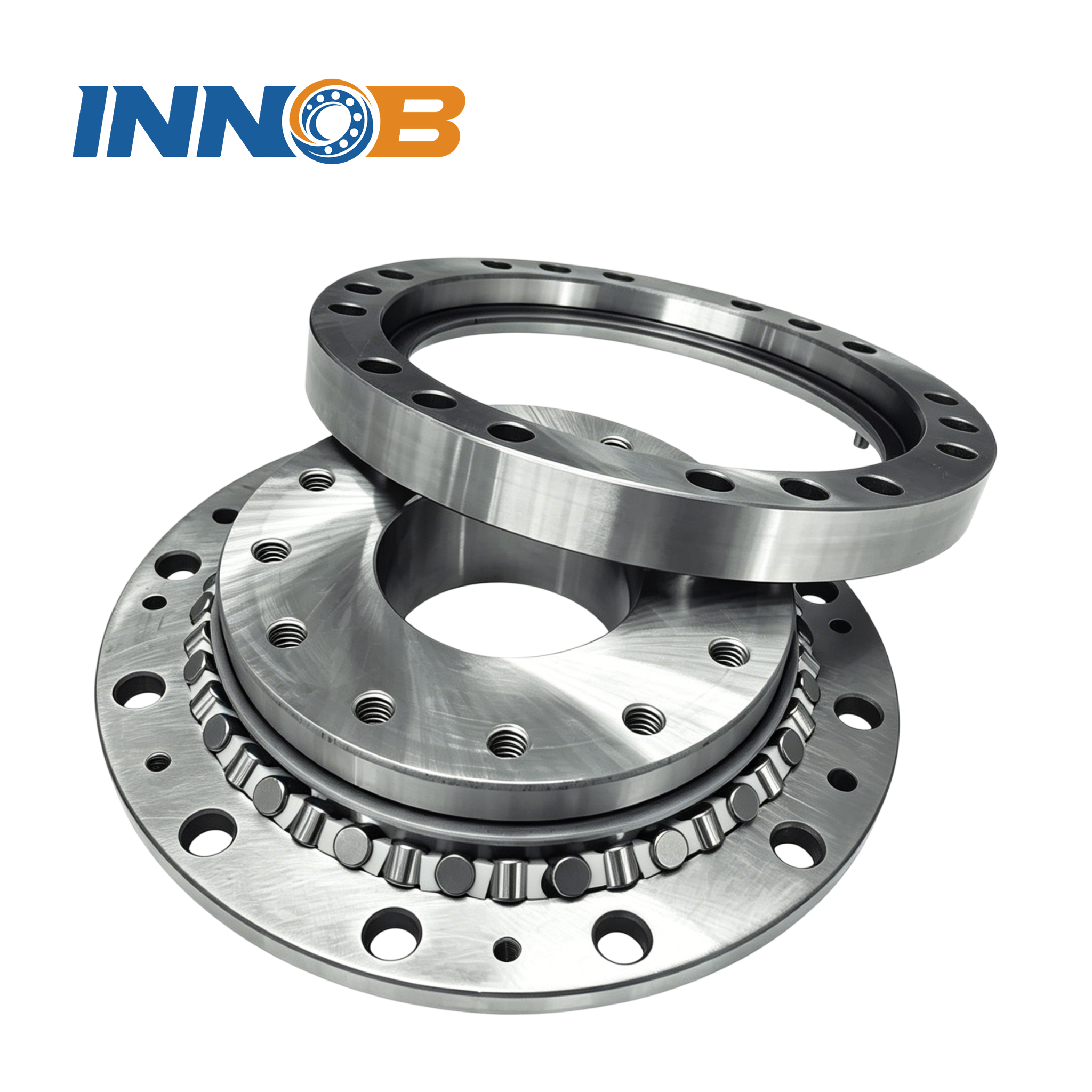
Crossed cylindrical roller. Rollers are arranged at 90° to one another in a
single raceway (or in matched V-grooves), each roller line carrying one load direction. The contact
between roller and raceway is a line, not a point. That one word — line — is where almost
all of the performance difference comes from.
2. Point contact vs line contact: the physics that matters
A ball touches its raceway at a small elliptical patch. A roller touches along its full length.
Under the same diameter and preload, the roller spreads the load over a vastly larger area, so:
- Capacity: a roller of a given diameter carries roughly 2–5×
the load of a ball in the same envelope. - Stiffness: line contact deflects far less under moment, so the ring holds its
angular position. That is why precision equipment reaches for rollers. - Brinelling resistance: a parked ring sitting under a static peak load dents a
ball groove sooner than a roller line. Rollers shrug off dwell-under-load better.
The trade you accept for that capacity is friction and sensitivity: rollers need a consistent
grease film, and they punish misalignment with edge loading more harshly than balls do.
3. Side-by-side comparison
| Criterion | Four-point ball | Crossed roller |
|---|---|---|
| Load capacity per envelope | Moderate | High (2–5× a same-size ball) |
| Stiffness / deflection under moment | Lower | Much higher |
| Overturning-moment capacity | Good | Excellent |
| Rotational speed | Better — lower friction at speed | Limited — build more heat |
| Start torque & variation | Can “skip” between contact points | Smooth, repeatable |
| Envelope / axial height | Slightly taller for same capacity | More capacity per height |
| Tolerance of misalignment | More forgiving | Less forgiving (edge loading) |
| Relative cost | Lower | Higher |
| Typical sweet spot | Cranes, excavators, large & cost-driven | Robotics, antenna, medical, machine tools |
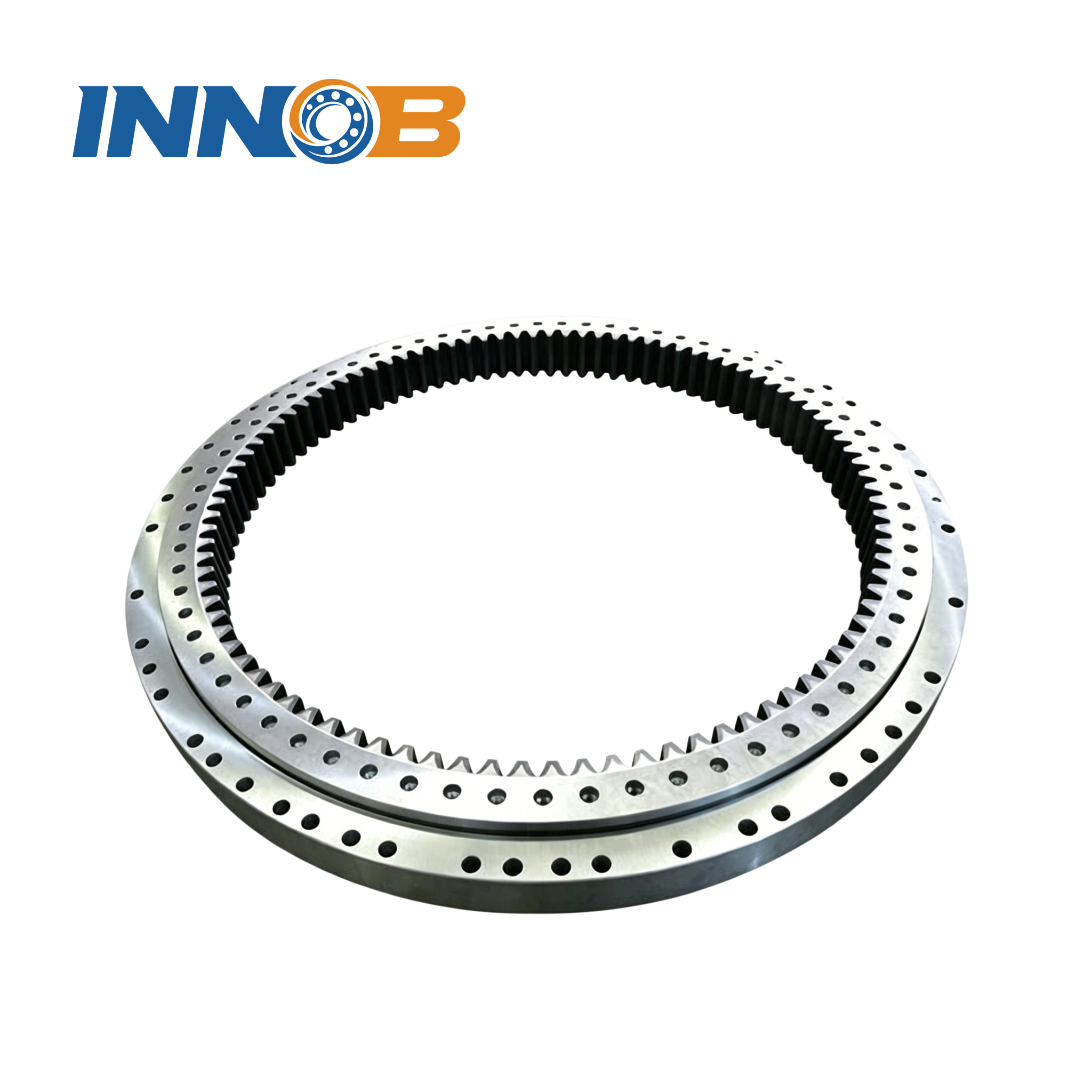
4. When to choose crossed roller
Use the decision rule below. If most of these are true, the roller ring is the right call:
- Moment-dominated duty. If the overturning moment M is large relative
to the axial force, rollers resist tipping far better than balls. - Precision or low deflection is required. Robotics joints, radar and SATCOM
pedestals, medical CT gantries, and machine-tool rotary tables all need the ring to hold angle
under load — that is a stiffness problem, and rollers win it. - The envelope is tight but the load is not. Rollers deliver more capacity per
unit height, so you can meet a duty in a shorter stack-up. - Smooth, repeatable indexing matters. Line-contact friction varies less than
the four-point “skip” of a ball, giving steadier start torque. - Long dwell under peak static load. A parked position holding a heavy moment
is kinder to rollers than to ball grooves.
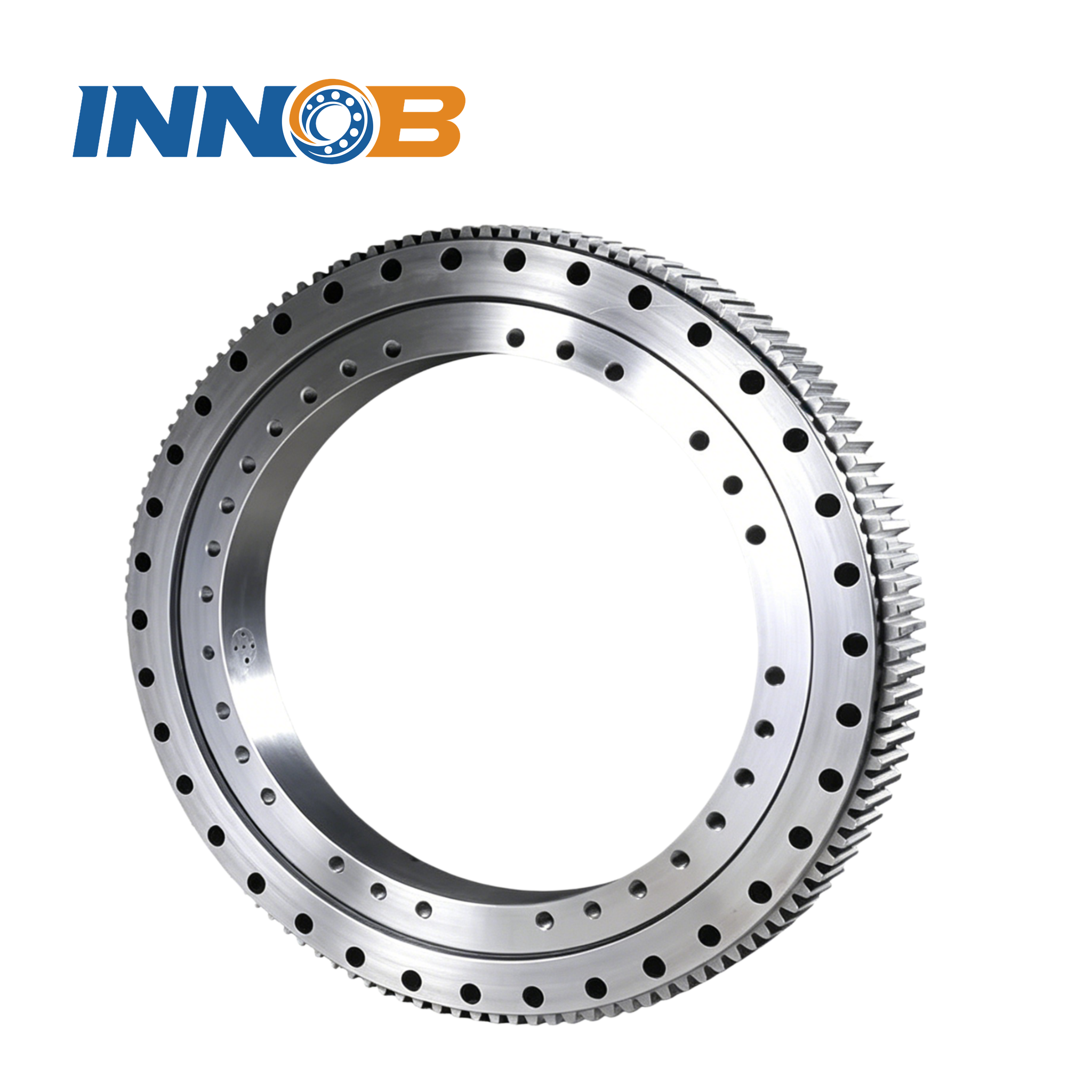
5. When the ball types are the better buy
“Roller is stronger” is not the same as “roller is right.” Reach for four-point (or double-row)
ball rings when:
- The combined load is light to moderate and the budget is the constraint.
- Rotational speed is high. Balls run cooler and with less friction at speed;
a crossed roller builds heat and is generally speed-limited. - The diameter is large and the moment modest — a big ball ring is cheaper to
manufacture than a big roller ring. - Some radial compliance is acceptable, or a single row doing everything keeps
the bill of materials simple.
For tower and mobile cranes, excavators, and aerial-work platforms, the four-point ball ring
remains the volume choice for exactly these reasons.
6. Sizing example: same duty, two rings
Take a duty of pitch diameter D ≈ 1.2 m, axial Fa = 180 kN, radial
Fr = 60 kN, overturning moment M = 320 kN·m. The moment dominates.
Carried on a four-point ball ring, meeting that moment usually means accepting a
larger pitch diameter or a lower static safety factor, because the ball’s point contact caps how much
moment a given D can hold. Swap to a crossed-roller ring of the same
D and the line contact lifts the moment capacity substantially — so you either hold the same
envelope with a healthier safety factor, or shrink D and recover stack-up height.
Figures here are illustrative of the trade, not a substitute for the manufacturer’s
rating curves. Send us your three load components, speed, and duty cycle and we will size both types
and quote them side by side.
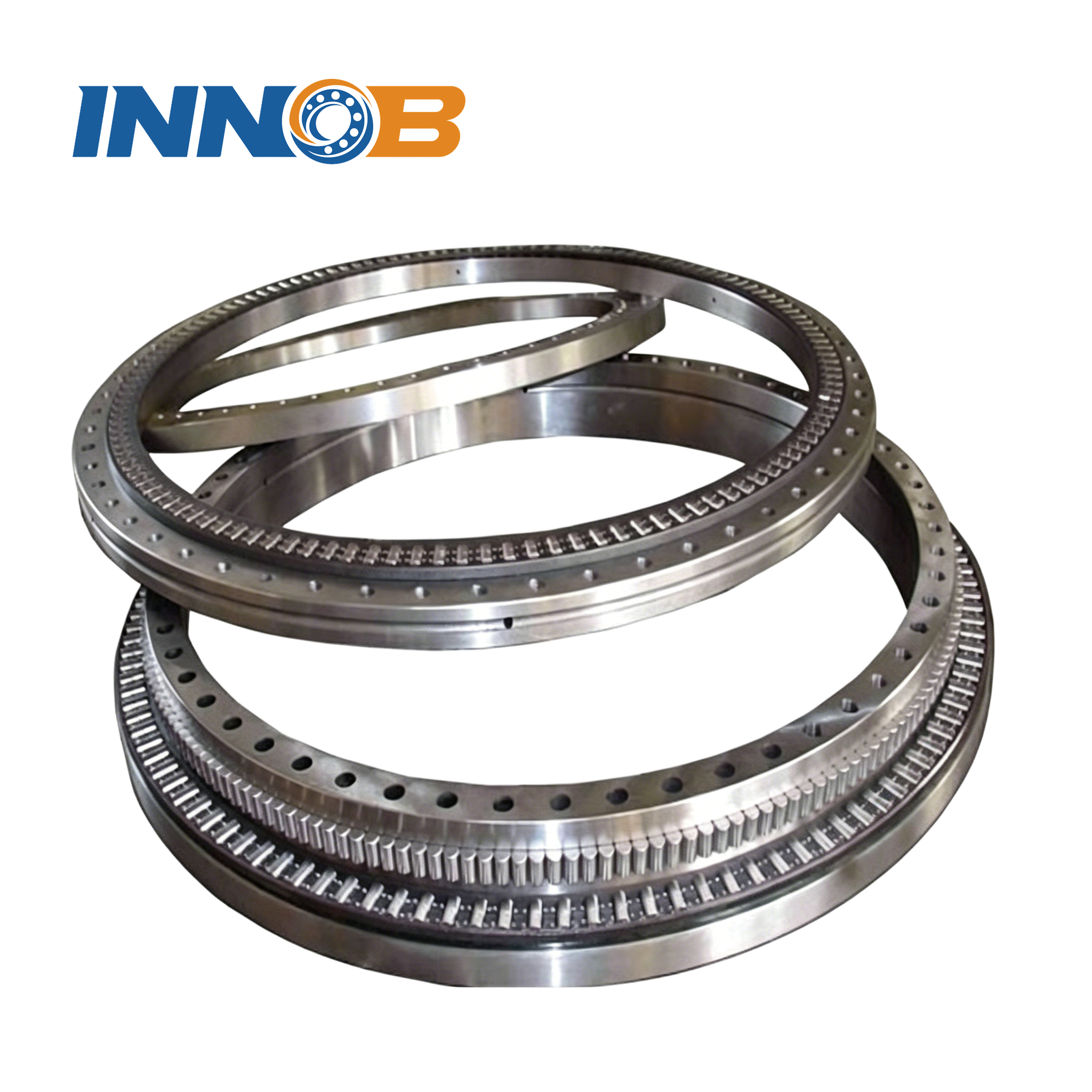
7. Where crossed roller is the wrong answer
- Continuous high-speed rotation. Use a ball ring or a dedicated thrust/radial
combination; rollers build heat. - Gross misalignment or a soft foundation. Rollers are unforgiving of edge
loading. A ball ring tolerates more. - Light-duty and budget-constrained. Paying for roller capacity you will never
use just adds cost and height.
8. Application map
| Application | Preferred type | Why |
|---|---|---|
| Robotics, AGV, semiconductor handling | Crossed roller | Stiffness, repeatability |
| Radar, antenna, SATCOM pedestals | Crossed roller | Moment + smooth indexing |
| Medical imaging gantries | Crossed roller | Low deflection, quiet |
| Machine-tool rotary tables | Crossed roller | Precision under cut load |
| Tower & mobile cranes | Four-point ball / three-row | Large dia, cost, speed |
| Excavators, aerial-work platforms | Four-point ball | Cost, speed, radial |
| Wind yaw & pitch | Four-point ball / special | Speed + cost |
| Heavy indexing turntables | Crossed roller | Moment + repeatability |

9. What to send us for a quote
To size both types and compare, give us:
- The three load components — Fa, Fr, and M — at the worst case.
- Rotational speed and duty cycle (continuous vs intermittent, dwell time under load).
- The envelope limit (max diameter and height you can accept).
- Mounting-face flatness you can hold — see our
rolling-mill bearing selection notes for how face geometry feeds bearing life.
10. Three mistakes to avoid
- Specifying a ball ring where moment dominates. It develops play and noise
early; the ring was never sized for the tipping load. - Assuming “roller = always better.” You overpay and may create a misalignment
fragility the application did not need. - Confusing crossed-roller with three-row. Crossed roller is one compact row for
combined load; three-row splits axial, radial, and moment into three rows for the highest
moment capacity at a taller stack-up.
Get a sized comparison, not a guess
If you know the load case, we will size a crossed-roller and a four-point ball ring for the same
duty and quote them side by side — so the choice is made on capacity, envelope, and cost, not habit.
Contact our engineering team with your Fa, Fr, M,
speed, and envelope limit.


